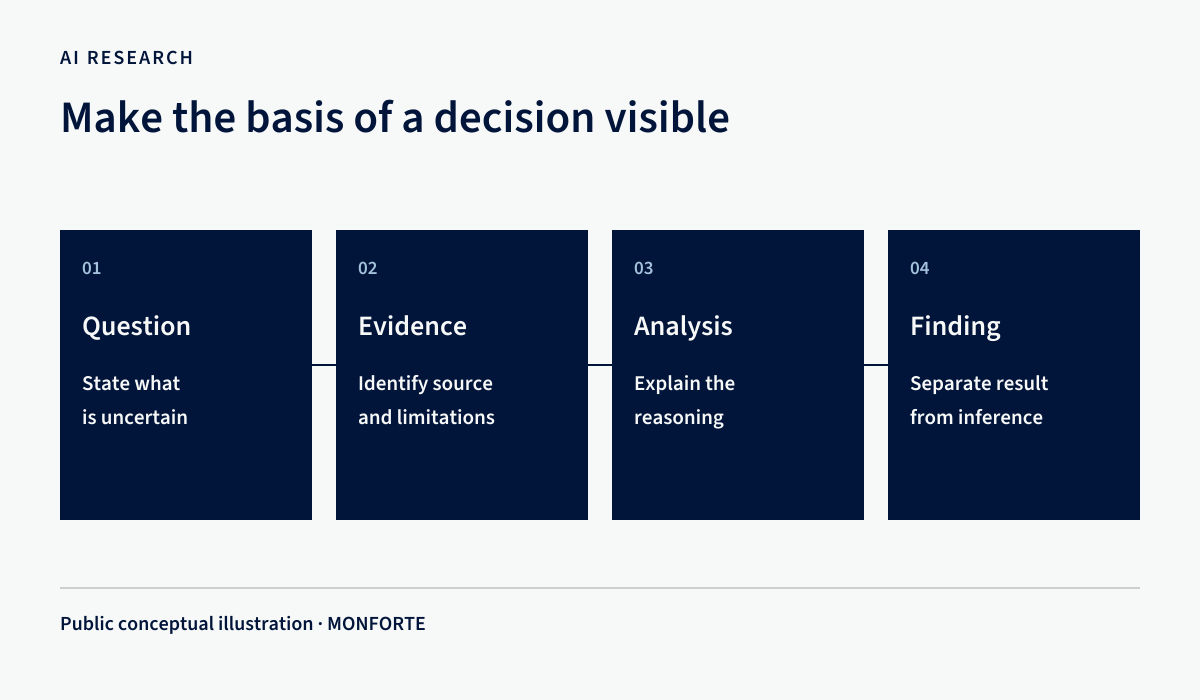

The questions we examine
AI creates new questions about authority, organizational design, human control, competence, and the evidence needed to explain decisions. The AI Research Division examines these questions and their implications for institutions.
Research connected to practice
Research has a distinct role within Monforte. It makes assumptions explicit, develops concepts and models, and subjects explanations to examination. Its work informs Edifice, education, and professional services while preserving the distinction between a research finding and a proposed method.
Research pending publication
These five manuscripts from the Resident Research Group connect accountability, governance architecture, organizational design, and practical assessment. The synopses introduce their arguments and proposed methods.
The Accountable Machine
AI-Augmented Governance and the Non-Delegable Accountability Principle
If AI is used to help govern AI, who remains answerable when either system fails? This paper examines the chain of oversight created by automated governance and argues that adding technical layers cannot, by itself, resolve accountability.
It proposes the Non-Delegable Accountability Principle: governance tasks may be automated, while ultimate accountability remains with an identifiable human or institution. The paper develops four conditions for that responsibility to be meaningful: clear identity, authority to intervene, access to understandable information, and reachability by affected parties. Its contribution is a conceptual foundation for designing AI-assisted oversight around an accountable human authority.
Governing the Ungovernable
A Process-Centric, Multi-Agent Architecture for Capability-Aware AI Governance
This paper proposes an architecture for combining machine-speed oversight with human accountability. It treats AI as part of an organizational process and connects a structured risk taxonomy, a governance orchestration layer, and specialist monitoring agents under a named AI System Owner.
The proposed design addresses the timing, resolution, coverage, and intervention capacity of governance. It includes bounded authority for automated responses and independently accessible logs so the owner can check summarized signals. The Governance Sustainability Horizon provides a proposed way to identify when expanding AI capabilities begin to exceed the architecture’s capacity to govern them.
Capability–Governance Asymmetry (CGA) Model Testing Worksheet
An Instrument-Grade Assessment Tool
This companion worksheet translates the Capability–Governance Asymmetry model into a structured case-assessment process. It asks practitioners to document an AI system’s context, capability, governance arrangements, and opacity, then examine governance timing, monitoring resolution, action coverage, and the ability to intervene before harm occurs.
A separate accountability check examines whether a responsible human or institution is identifiable, empowered, informed, and reachable. The worksheet supports recording failure modes, supporting evidence, and proposed interventions. Its scores are described as directional; the instrument is intended to support consistent case comparison and empirical testing of the model.
The Governed Ecosystem
Organisational Design for the Agentic AI Transition
How should an organization change when AI systems act continuously across established process boundaries? This paper argues that agentic AI calls for continuing “change engineering”: designing, monitoring, and maintaining the conditions under which evolving systems remain aligned with organizational intent.
It proposes the System Governance Agreement as an explicit definition of acceptable behavior and outcomes, supported by monitoring, intervention, and regular review. The paper examines human roles centered on governance decisions, accountability across process interfaces, and a five-stage maturity model. It identifies adaptive governance as an open research question: how oversight can itself evolve while retaining meaningful human accountability.
Edifice™ Practitioner Bridge
From Compliance to Parity
This practitioner paper connects the research series to governance implementation. It presents a proposed crosswalk between Edifice’s architecture and selected provisions of the NIST AI Risk Management Framework, the EU AI Act, ISO/IEC 42001, and the March 2026 draft of GSAR 552.239-7001.
The discussion examines incident response, named ownership, organizational readiness, and the evidence needed to support oversight. Supporting tools include a checklist, an AI System Owner appointment template, and a dashboard reference layout. The synopsis reflects the draft’s proposed mappings; it does not establish that implementation meets every applicable legal or certification requirement.
How to read our work
The manuscripts listed here are pending publication. Their proposed principles, architectures, and assessment methods remain open to examination and refinement. Published newsletter articles and other professional commentary are available through Insights.
Research conversations
We welcome clearly framed questions, methodological discussion, and opportunities to connect inquiry with organizational experience. An initial inquiry should describe the question and the kind of contribution being considered. Confidential evidence should be shared only through an agreed engagement process.